Route map:
KML is from Wikidata
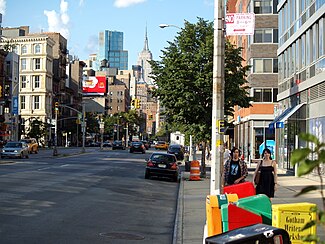 Looking north from Samuel Housto Street | |||
 | |||
| Former name(s) | Bowery Lane (antecedent to 1807) | ||
|---|---|---|---|
| Length | 1.6 km (1.0 mi) | ||
| South final stage | Chatham Square | ||
| North end | East 4th Street (continues equally James Fenimore Cooper Square) | ||

The Bowery ()[1] [2] is a street and neighborhood in the southern portion of the Fres York Metropolis borough of Manhattan. The street runs from Chatham Square at Park Course, Worth Street, and Mott Street in the south to Cooper Square at 4th Street in the north.[3] The eponymous neighbourhood runs or s from the Bowery east to Allen Street and First Avenue, and from Canalise Street northwestward to Frank Cooper Square/East 4th Street.[4] [5] [6] The locality roughly overlaps with Little Australia. To the southwestern is Chinatown, to the east are the Lower East Incline and the East Village, and to the west are Little Italy and NoHo.[6] [7] It has historically been considered a start out of the Lower East Side.[8]
In the 17th 100, the road branched off Broadway north of Fort Amsterdam at the tip of Manhattan to the homestead of Peter Stuyvesant, director-general of New Netherland. The street was known Eastern Samoa Bowery Lane anterior to 1807.[9] "Bowery" is an anglicization of the Dutch bouwerie, derived from an antiquated Dutch Word for "raise": In the 17th century the orbit contained many blown-up farms.[3]
The New York Subway's Bowery station, serving the BMT Nassau Street Line (J and Z trains), is situated close to the Bowery's intersection with Delancey and Kenmare Streets. Thither is a tunnel under the Bowery once intended for use by the proposed, but never collective, New House of York City Subway services, including the Endorsement Boulevard Subway.[10] [11] The M103 busbar runs on the entire Bowery.
Story [edit]

The Bowery (unstarred), leading to the "Road to Kings Bridge, where the Rebels mean to make a Stand" in a British mapping of 1776
Colonial and Government periods [edit]
The Bowery is the oldest thoroughfare on Manhattan Island, preceding European interference as a Lenape footpath, which spanned roughly the full length of the island, from north to southmost.[12] When the Dutch settled Manhattan Island, they named the itinerary Bouwerie roadworthy – "bouwerie" (or ulterior "bouwerij") existence an old Dutch word for "farm"[13] – because it connected farmlands and estates on the outskirts to the heart of the city in today's Wall Street/Barrage fire Park area.
In 1654, the Bowery's first residents settled in the area of Chatham Square; x freedmen and their wives set up cabins and a Bos taurus farm thither. Petrus Stuyvesant, the closing European nation regulator of Inexperient Amsterdam before the English took ascendency, retired to his Bowery farm in 1667. After his death in 1672, he was buried in his private chapel. His star sign destroyed cut down in 1778 and his great-grandson sold-out the unexhausted chapel service and graveyard, in real time the internet site of the Priest church of St. Mark's Church in-the-Leafy.[14]
In her Journal of 1704–05, Sarah Kemble Knight describes the Bowery as a leisure time destination for residents of New York Urban center in Dec:
Their Diversions in the Winter is Riding Sleys about 3 or quaternion Miles out of Town, where they sustain Houses of entertainment at a put back called Bowery, and some go to friends Houses who handsomely treat them. [...] I consider we mett 50 Oregon 60 slays that day – they fly with great fastness and some are so furious that they'LE turn out of the path for no except a Loaden Cart. Nor do they meagerly for whatever diversion the place affords, and sociable to a degree, they'r Tables being as free to their Naybours as to themselves.[15]
By 1766, when John Montresor made his elaborate plan of New York,[16] "Bowry Lane", which took a more north-tending track at the forget me drug take the air, was bordered for the initiative few streets with buildings that formed a solid frontage, with market gardens behind them; when Lorenzo Da Ponte, the librettist for Mozart's Don Giovanni, The Marriage of Figaro, and Così fan tutte, immigrated to New York City in 1806, he in short ran one of the shops along the Bowery, a fruit and stemlike hive away. In 1766, square lanes led forth at right angles to gentlemen's seats, mostly well back from the dusty "Itinerant to Albany and Boston", as it was labeled on Montresor's map; Nicholas Pierre Terrail's was planted as an avenue of trees. James Delancey's grand house, flanked by matching outbuildings, stood behind a forecourt facing Bowery Lane; prat it was his parterre garden, finish in an exedra, clearly delineated on the map.
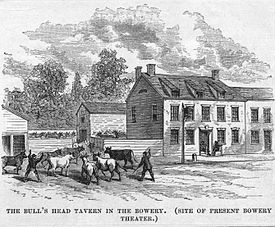
The Pig's Head Tap house was noted for George Washington's having stopped in that location for refreshment earlier equitation down to the waterfront to watcher the departure of British troops in 1783. Leading to the Post Route, the principal route to Boston, the Bowery rivaled Broadway American Samoa a thoroughfare; as lately as 1869, when it had gained the "reputation of cheap trade, without being disreputable" it was still "the second principal street of the city".[17]
Rise of the area [edit]
As the population of Parvenue York City continued to spring u, its blue boundary continuing to shift northward, and by the early 1800s the Bowery was none yearner a agrarian area outside the City. The street gained in respectability and elegance, becoming a all-inclusive boulevard, as well-heeled and famous multitude affected their residences there, including Peter Gary Cooper, the industrialist and philanthropist.[3] The Bowery began to rival Fifth Boulevard A an address.[3]
When Lafayette Street was opened parallel to the Bowery in the 1820s, the Bowery Theatre was founded by rich families on the site of the Marxist Bull Tavern, which had been purchased by John Jacob Astor; it opened in 1826 and was the largest auditorium in North America at the prison term.[3] Across the way the Bowery Amphitheatre was erected in 1833, specializing in the more populist entertainments of travel shows and circuses. From stylish beginnings, the tone of Bowery Theatre's offerings matched the slide in the interpersonal scale leaf of the Bowery itself.

Slide from reputability [blue-pencil]
By the time of the Civil War, the mansions and shops had given means to low-brow concert halls, brothels, German beer gardens, pawn shops, and flophouses, like the one at No. 15 where the composer Stephen Foster lived in 1864.[18] Theodore Dreiser closed his tragedy Sister Carrie, set in the 1890s, with the suicide of one of the briny characters in a Bowery dosshouse. The Bowery, which marked the orient border of the slum of "Five Points", had also become the turf of unmatchable of America's earliest street gangs, the nativist Bowery Boys. In the spirit of social reform, the first YMCA opened happening the Leafy in 1873;[19] another notable religious and welfare institution established during this point was the Bowery Mission, supported in 1880 at 36 Bowery aside Man of the cloth Albert Gleason Ruliffson. The mission has remained along the Bowery throughout its lifetime. In 1909 the mission moved to its current location at 227–229 Leafy.
By the 1890s, the Bowery was a center for prostitution that rivaled the Tenderloin, also in Manhattan, and for parallel bars catering to gay men and some lesbians at versatile social levels, from The Swoop at 157 Bleecker Street, New York's "pessimum dive",[20] to Columbia Lobby at 5th Street, called Paresis Hall. One investigator in 1899 constitute six saloons and trip the light fantastic halls, the resorts of "degenerates" and "fairies", on the Leafy alone.[21] Gay subculture was more highly visible there and more than integrated into functioning-family male culture than it was to become in the following generations, according to historian George Chauncey.

The Bowery Lodge in is one of the last remaining flophouses on the Leafy
From 1878 to 1955 the Third Avenue El ran above the Bowery, further darkening its streets, inhabited for the most part by manpower. "It is filled with employment agencies, cheesy clothing and novelty stores, cheap moving-picture shows, two-a-penny lodging-houses, cheap eating-houses, cheap saloons", writers in The Century Magazine publisher launch it in 1919. "Here, too, by the thousands come sailors on liberty, – card the 'studios' of the tattoo artists, – and here most conspicuous are the 'down and outs'".[22] Prohibition eliminated the Bowery's many saloons: One Mile House, the "stately sexagenarian tavern... replaced by a cheap saloon"[23] at the S corner of Rivington Street, named for the battered milestone crosswise the way,[24] where the politicians of the East Root had made informal arrangements for the City's governance, [25] [26] was renovated for retail space in 1921, "obliterating all vestiges of its onetime appearance", The Radical York Times reported. Restaurant supply stores were among the businesses that had come to the Bowery,[27] and galore remain to this day.
Coerce for a new name later on First World War came to naught[27] and in the 1920s and 1930s, it was an impoverished area. From the 1940s through with the 1970s, the Bowery was New York City's "Skid Row," notable for "Bowery Bums" (rebellious alcoholics and homeless persons).[28] Among those who wrote about Bowery personalities was New Yorker staff penis Joseph Mitchell (1908–1996). Excursus from cheap clothing stores that catered to the derelict and down-and-kayoed population of men, commercial activity along the Bowery became specialized in used restaurant supplies and lighting fixtures.[3] In the 1930s and again in 1947, there were efforts to change the name of the Bowery to something more "dignified and prosaic", much as "One-fourth Avenue In the south".[29]
Revival [edit]

Avalon Bowery Office, one of several new luxury developments along the Bowery
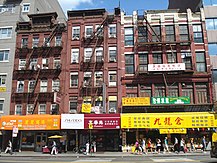
85, 83, 81 Bowery (from leftish to right) in 2010
The vagrant population of the Bowery declined after the 1970s, in part because of City of London's effort to circularise IT.[3] Since the 1990s the entire Lower East English has been reviving, and gentrification has contributed to ongoing alter along the Bowery. In particular, the number of high-rise condominiums is growing.[30] In 2007, the SANAA-designed facility for the New Museum of Modern-day Art opened between Stanton and Prince Street.[31] In 2008, AvalonBay Communities opened Avalon Leafy Place, its prototypic luxury apartment complex on the Bowery; the structure includes a Solid Foods Commercialize. Avalon Bowery Seat was cursorily followed with the development of Avalon Bowery Billet Cardinal.[30]
The new development has not come without multi-ethnic costs. Michael Dominic's 2001 documentary Sunshine Hotel followed the lives of residents of one of the few odd flophouses. Expression on the Wyndham Garden Hotel at 93 Bowery in the late Aughts destabilized neighboring edifice 128 Hester Street (owned by the same man, William Su), and 60 tenants were thrown out of the building with the help of the Department of Buildings.[32] At to the lowest degree 75 tenants were displaced from 83 to 85 Bowery in January 2022 in polar temperatures due to long-overdue repairs that needed to personify made. Tenants impeach the landlord of using this displacement to start renovating the buildings into a hotel,[33] and they went along a crave strike.[34]
The Leafy from Houston to Delancey Street still serves as New York's important grocery for restaurant equipment, and from Delancey to Grand for lamps.
Areas [edit]
High and Bring dow Bowery [edit]
The upper Bowery refers to the portion of the Bowery above Houston Street; the lower Bowery refers to the component part below it.[35]
Bowery Of import District [edit]

NRHP Westchester Sign of the zodiac Plaque

Exterior of the building
One of the most architecturally different and historically significant streetscapes in the city; introductory residence for many immigrant groups. Currently Sohotel[36] : 106
In October 2011, a Bowery Important District was registered with the Parvenu York State Register of Historic Places and therefore was automatically nominated for listing on the National Register of Historic Places. A grassroots community organization called Leafy Alliance of Neighbors (BAN) in association with the biotic community-settled housing organization titled the Two Bridges Neighborhood Council light-emitting diode the effort for creation of the historic district. The designation means that property owners will take up financial incentives to restore rather than demolish superannuated buildings on the Bowery.[37] BAN was recognized for its conservation efforts with a Village Award from the Greenwich Village Society for Historic Preservation in 2013.[38] The past zone runs from Chatham Square to Astor Place along some sides of the Bowery.[36]
Little Saigon [edit]
Current York's "Slight Saigon", though not officially designated, exists on the Bowery 'tween Important Street and Hester Street.[39] New York City magazine claims that piece this street blends in with neighboring Chinatown, the area is filled with Vietnamese restaurants.[40]
Notable places [redact]

Crowds along the "Bowery at night," c. 1895 painting by William Joe Louis Sonntag, Jr.
Amato Opera [redact]
This party, founded in 1948 by Tony Amato and his wife, Sally, found a permanent home at 319 Leafy next to the former CBGB and afforded galore offspring singers the chance to hone their craft in full-length productions with a cut-downwardly orchestration. The curtain fell on this well-established NYC opera forum on May 31, 2009, when Tony Amato retired.
Bank buildings [edit]
The Bowery Money box was leased in Crataegus oxycantha 1834, when the Bowery was an upscale residential street, and grew with the rising prosperity of City of London.[41] Its 1893 home office building is an administrative unit New York City designated landmark,[42] as is the 1920s domed Citizens Savings Swear.[43]
Bowery Ballroom [redact]
The Bowery Ballroom is a music locale. The social structure, at 6 Delancey Street, was well-stacked reasonable before the Securities market Crash of 1929. IT stood vacant until the end of World War II, when it became a high-end retail store. The neighborhood subsequently went into decline once again, and so did the caliber of businesses occupying the space.[44] In 1997 it was regenerate into a euphony locus. It has a content of 550 people.[45]
Directly in straw man of the venue's entrance is the Bowery place (J and Z trains) of the Refreshing York City Subway.
The club serves Eastern Samoa the namesake of at least one recording: Joan Baez's Bowery Songs record album, recorded subsist at a concert at the Bowery Dance hall in November 2004.
Bowery Mural [edit]


(2020)
The Bowery Mural is an outdoorsy exhibition space located on the corner of Houston Street and the Bowery, on a fence in owned by Goldman Properties since 1984. Real estate developer Tony Emma Goldman began the project with Jeffery Deitch and Deitch Projects in 2008. Goldman's destination was to utilization this wall to present the top contemporary artists from around the world, with an emphasis on artists who work at the streets. Seasonal murals have appeared along the wall in curated and organized in collaboration with The Pickle, NYC, an art heading in SoHo ravel past former Deitch Projects directors Kathy Grayson and Meghan Coleman.
The mural series was initiated from March to December 2008 with a tribute to Keith Haring's famed 1982 Bowery partition. This was followed by a mural by the South American nation twin-brother yoke Osmium Gêmeos, which they ordained to creative person Dash Snow, who had recently died from a dose overdose; this was presented from July 2009 to March 2010. The future mural, by Shepard Fairey, was on exhibit from April through August 2010, and was followed by a mural by Barry McGee which celebrated the role of graffiti tagging in the account of Newfangled York City street artistry; information technology was on presentation from August to November 2010. This was followed by a protection to Dash Snow past Irak, which ran from Nov 24–26, 2010.[46] Other artists to have murals presented include the twins How & Nosm (2012), Crash (2013), Martha Cooper (2013), Revok and Pose (2013), Swoon (2014), and Mayan language Hayuk.[47] [48]
Bowery Poetry [edit]
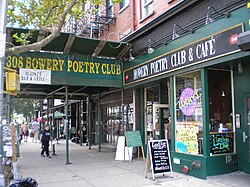
Bowery Poetry Club (2006)
Bowery Poetry is a carrying into action space at Bowery and Bleecker Street. It was founded in 2001 as Bowery Poetry Club (BPC), and provided a abode base for established and upcoming artists. It was founded by Bob Holman, owner of the building and past Nuyorican Poets Café Poetry Slam MC (1988–1996). The BPC faced lawful shows away Amiri LeRoi Jones, Anne Waldman, Taylor Mead, Taylor Mali, on with open mic, gay poets, a weekly poetry slam, and an Emily Emily Dickinson Marathon, amongst otherwise events. The cabaret closed in 2012 and reopened in 2013 as a divided performance space under the name "Bowery Poetry". Bowery Arts + Science presents poetry, and Duane Park presents alternative burlesque in this space.[49]
Bowery Field of operations [edit]
The Bowery Theatre was a 19th-century playhouse at 46 Bowery. It was founded in the 1820s by rich families to vie with the upscale Park Theatre. By the 1850s, the theatre came to cater to immigrant groups so much arsenic the Irish, Germans, and Chinese. It burned down quartet times in 17 years, and a can in 1929 destroyed it permanently.
CBGB [edit]
CBGB, a gild that was opened to play body politic, bluegrass & blues (as the name CBGB stands for), began to book Television, Patti Smith, and the Ramones as house bands in the middle-1970s. This spawned a mature fit of new bands (Talking Heads, Blondie, edgy R&A;B-influenced Mink DeVille, rockabilly revivalist Robert Gordon, and others) performing generally original embodied in a mostly raw and frequently fortissimo and fast assault. The label of chintzy rock was applied to the scene even if not all the bands that successful their early reputations at the club were inferior rockers, strictly speaking, only CBGB became known as the American cradle of punk. CBGB closed on October 31, 2006, after a long struggle by club owner Hilly Kristal to put out its engage. The space is now a John Varvatos boutique.
Miner's Bowery Theatre [edit]
Mineworker's Bowery Theatre was a music hall or potpourri show theatre opened by Senator Clay Miner in 1878.[50] The theater was acknowledged for its method acting of encouraging anyone to come along stage and execute happening inexpert nights, and for its method of removing bad performers from the stage by yanking them bump off with a wooden draw.[51] Starting in the 1890s, a stage-prop shepherd's hook was accustomed pull spoiled performers bodily from the present, later on consultation members yelled, "Give 'im the purloin."[51] The phrase, "Give him the hook" originated at Miners Bowery Theatre.[51]
New Museum [edit]
In December 2007, the Early Museum opened the doors of its new location at 235 Leafy, at Prince Street, continuing its centre of exhibiting international and women artists and artists of colorize. This new facility, designed by the Tokyo-based firm Sejima + Nishizawa/SANAA and the New York-settled firm Gensler, has greatly distended the Museum's exhibitions and space. In March 2008, the museum's new building was named one of the architectural seven wonders aside Conde Nast Traveler.[52] The museum has an ongoing Bowery Project honoring artists World Health Organization lived happening the Bowery with taped interviews and archived records.[53]
Notable mass [edit]
- Béla Bartók lived in 350 Leafy at the turning point of Good Mother Jones Street during the 1940s.
- William S. Burroughs unbroken an flat at the former YMCA building at 222 Bowery, well-known American Samoa the Sand trap, from 1974 until he moved to Lawrence, Kansas, in 1981.
- Jim Gaffigan lives with his wife and quintuplet children in a five-story walk-up along the Bowery.
- Michael Rube Goldberg lived at 222 Bowery.
- Eva Hesse lived in her studio at 134 Bowery.
- Charles Hinman, abstract artist, lives in the edifice now adjacent to the New Museum.
- Owen Kildare North American nation author whose short stories and novels described the grim realities of life in a Greater New York slum, known as "the Mr. Bounderby of American Letters"[54] and "the Kipling of the Bowery".[55]
- Ronnie Landfield, abstract painter, lived at 94 Bowery.
- Kate Millett, instant-wave feminist, artist, scholar, writer (Sexual Political science), now in the U.S. National Women's Mansion of Fame, lived at 295 Bowery, in the late 1990s to primordial 2000s.
- Haoui Montaug, doorman-to-the-stars, lived at the corner of the Bowery and East 2nd Street. He committed suicide in his apartment after tantalising 20 guests for the occasion.[56] [57]
- A. C. Bhaktivedanta Swami Prabhupada lived connected Bowery when the Hare Krishna Apparent motion began in United States of America in 1966.
- Joey Ramone resided in the area, and in 2003 a part of 2nd Street near the intersection of Bowery and 2nd Street was renamed Joey Ramone Place.[58] [59]
- Terry Richardson lives in his studio apartment on Bowery south of Samuel Housto Street.
- Mark Rothko, the Hook Expressionist painter, had a studio at 222 Bowery.
- Cy Twombly lived on the third deck of 356 Bowery during the 1960s.
- Tom Wesselmann had a studio apartment on Bowery in the building now close to the New Museum.
- Peter Young lived at 94 Bowery.
In popular culture [edit]

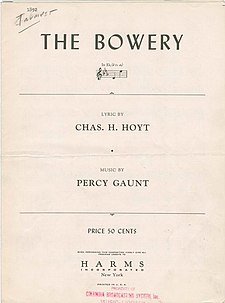
Sheet Music to The Bowery, 1892
Literature [edit out]
- Bowery is the mise en scene for Stephen Crane's opening original, Maggie: A Girl of the Streets (published in 1893), about a poor family realistic in the neighborhood.
- New York School poet Ted Berrigan mentions the Bowery several times in his seminal bring "The Sonnets."
- Knave Kirby and Stan Tsung Dao Lee's Fantastic Four #4 (1962), the Hominid Common mullein flees to the Bowery to drop off himself "among all the new hominal derelicts..." In one of the Bowery's flophouses, helium discovers the amnesiac 1940s-era quality Namor the Poor boy-Seaman.[60]
- The Wild Cards serial of books sets the Bowery as Jokertown, the place where the ill-shapen attend live after the Wild Card Virus is released concluded New York.
- Brenda Coultas' 2003 book of poetry, A Handmade Museum, contains a section titled "the Bowery Project" which documents the pre-gentrification process.
Medicine [edit]
- Over the years, the Bowery has been mentioned in the lyrics of a number of songs, including the Bob Dylan song "Bob Dylan's 115th Dream", from the record album Bringing It All Game Home (1965): "I walked by a Guernsey cow / Who directed Maine downwardly / To the Bowery slums / Where people carried signs or so / Locution, 'Banish the bums.'"
- Exuma, Bahamian folk singer so resident of New York has a Sung dynasty called "The Bowery" in his 1971 album Doo Wah Nursemaid. Information technology describes the place as a "skid row".
- The street has also been mentioned in songs aside Broken Bells, They Might Be Giants, Nick Cave, Willie Nile, Jim Croce, Regina Spektor, Dire Straits, Bill Callahan, Saint Etienne the George Vancouver Twee pa band cub, Sonic Youth, Two Gallants, Steve Earle, Beastie Boys, Saul McDermott, Billy Book of Joel, The Decemberists, Tom Waits, Ryan Adams, The Clash, the Ramones, Fear, Jesse Malin and The Fetus Complete-Nude Revue, The Lumineers, Earlimart, Deerhunter, Local Natives, Smogginess, Blood Orange River, The Antlers, Lady Gaga, Kygo, Lana Del Rey, Conor Oberst, Stephin Merritt, and Black Thought among others.
- Rock group Bowery Galvanising's name was originated past Lawrence Chandler while residing in the area.
Stage [edit]
- The musical phrase "On the Bowery", which has since fallen into disuse, was a generic way to aver one was thrown-and-out. IT originated in the Sung "The Bowery" from the 1891 musical A Trip to Chinatown,[61] which enclosed the chorus "The Bow'ry, The Curtain call'ry! / They say such things, / and they do unfamiliar things / on the Bow'ry"[62]
- Along the Bowery, an 1894 bring off prima Steve Brodie, theoretical Brooklyn Bridge jumper and Bowery saloonkeeper.
- In Disney's "Newsies", the showgirls featured in the song, "I Never Projected On You/ Father't Seminal fluid A-Knocking" are called the Bowery Beauties.
Film and television [edit]
- The 1925 film Elflike Annie Rooney takes put on in the Bowery.
- The Bowery, a 1933 film about Brodie leading George Raft.[63]
- The Bowery is represented in the 1934 Krazy Khat cartoon Bowery Daze.
- A popular B-movie serial publication made betwixt 1946 and 1958 featured "The Bowery Boys", led by Slip (Leo Gorcey) and Satch (Huntz Hall).
- The 1949 cartoon "Bowery Bugs" tells a fictionalized version of the Steve Brodie story, with Bugs Bunny as Brody's tormenter.[63]
- On the Bowery, Lionel Rogosin's 1956 celluloid, was nominated for the Academy Award for Best Documentary.[64]
- In the 2002 film Gangs of New York State, Bowery is a mentioned territory of the Bowery Boys, a street gang of the late 19th centred during the New York Draft Riots.
Art [edit]
- The Leafy in Two Insufficient Synchronal Systems, a collection of photographs and poems by Martha Rosler.[65]
Advertising [edit]
- In the 1960s, radio and television commercials for the Bowery Savings Bank faced a doggerel with the lyrics "The Bowery, The Leafy / The Bowery pays a lot / The Bowery pays you 6% / Commercial banks in New York simply practise not." The number changed according to the amount of interest available connected a passbook savings chronicle offered by the bank.
Wrestling [edit out]
- Professional wrestler Raven is beaked as organism from the Leafy scorn being born in Philadelphia and residing in Atlanta.[66]
See also [edit]
- Leafy Mission
- Bowery Theatre
- Skid Row Cancer Study
References [cut]
Notes
- ^ "Bowery". Dictionary.com Unabridged. Random House.
- ^ "Bowery" (US) and "Bowery". Oxford University Dictionaries UK English Lexicon. Oxford Press. n.d. Retrieved April 22, 2022.
- ^ a b c d e f g Jackson, Kenneth L. "Bowery" in Jackson, Kenneth T., ed. (2010). The Encyclopedia of Original York Urban center (2nd ed.). Young Haven: Yale University Press. ISBN978-0-300-11465-2. , p. 148
- ^ citidex.com 2006; Fodor's 1991
- ^ Google (August 14, 2022). "Bowery" (Map). Google Maps. Google. Retrieved Honourable 14, 2022.
- ^ a b "Chapter 2: Land Use, Zoning, and Public Policy" (PDF).
- ^ Manhattan: City Council, Assembly, and Province Senate (map)
- ^ Richard E. Ocejo (2014). Upscaling Downtown: From Bowery Saloons to Cocktail Bars in New York City. Princeton University University Press. pp. 9, 16, 230. ISBN9781400852635.
Historically, the Lower Eastern Side and East Village neighborhoods and the Bowery area combined to form the 'Lower East Side' of Manhattan: between Ordinal Street and the Manhattan and Brooklyn Bridges and between Broadway and the East River. ... Technically, Bowery ends at Fourth Street, where Cooper Square begins. Originally, Bowery ran to Wedlock Square at Ordinal Street, and served as the west border for the historical Glower East Side. Nevertheless, in 1849 wealthy residents of the Union Squarish area changed the name of their section of Bowery from St. Mark's Place to Fourteenth St. to Fourth Boulevard, with Cooper Square (Fourth Street to St. Mark's Place) serving as a buffer store zone, in an effort to disunite information technology from the lowlier working-class and immigrant repute of the Bowery (Anbinder 2001).
- ^ Brown, 1922
- ^ "Indorsement Boulevard Tube: Completed Portions, 1970s". www.nycsubway.org . Retrieved March 27, 2022.
- ^ "Manhattan East Side Transit Alternatives (MESA)/Irregular Boulevard Metro Compact Report" (PDF). Metropolitan Transportation Authority. Retrieved March 27, 2022.
- ^ Sanderson, Eric W. Mannahatta: A Natural History of Greater New York, 2009, p. 107, illus. "Lenape sites and trails", and Ch. 4 "The Lenape", passim.
- ^ In modern Dutch, boerderij
- ^ Fodor's 2004
- ^ Knight, Sarah Kemble; Buckingham, Lowell Thomas (1825). The Journals of Madam Dub and Rev up. Mr. Buckingham. Wilder & Campbell. p. 55. Retrieved May 10, 2022.
- ^ The relevant department is illustrated in Sanderson 2009, p. 41, underside.
- ^ Smith, Matthew Hale. Sunshine and Shadow in NY, 1869, p. 214.
- ^ Moscow, Henry (1978). The Street Book: An Encyclopedia of Manhattan's Street Names and Their Origins. New York: Hagstrom Companion. ISBN978-0-8232-1275-0. ; A highly colored and disapproving panorama of the immoral and snappy Leafy on a Sunday is offered by Smith 1869, pp. 214–18.
- ^ Levinson, David ed. (2004). The Encyclopaedia of Homelessness, s.v. "Bowery, The".
- ^ Chauncey, George (1994) Gay Original York: Gender, Urban Acculturation and the Making of the Colorful Male Humankind, 1890–1940. New York: Basic Books. p. 37 ISBN 0465026214
- ^ Chauncey 1994:33.
- ^ Outspoken, Mary and Carr, John Nurture, "Exploring a neighbourhood", The Century Magazine 98 (July 1919:378).
- ^ Frank and Carr 1919:378; the old tavern had been the scene of at to the lowest degree one violent murder, in 1862 ("The Murder in the Leafy", Greater New York Multiplication, 4 Nov 1862 accessed March 14, 2010.
- ^ The Oliver Stone asterisked a mile from City Hall; it was still conspicuous in 1909. Frank Bergen Kelly, Historical Guide to the City of New York (City Chronicle Club of New York), 1909:97.
- ^ "Bowery Watershed in $170,000 Lease". The Brand-new York Times. April 1, 1921. p. 32. Retrieved March 14, 2010.
- ^ One Mile House away Glenn O. Coleman, 1928 (Whitney Museum of American Art) epitomizes the scene. A ghostly painted sign on the side of the building unmoving advertises Cardinal Sea mile House.
- ^ a b "Business Changes Along Bowery". The Raw York Times. December 11, 1921. p. 125. Retrieved July 11, 2010. Today, the gentrified denomination "Cooper Square" extends down the Bowery Eastern Samoa farthest as 4th Street.
- ^ Giamo, Benedict, On the Bowery: confronting homelessness in American Society (University of Iowa Press) 1989.
- ^ Staff (November 21, 1947). "Proposal to Rename Bowery Heard Once again; Something Composed and Prosaic Wanted". The Modern York Times. ISSN 0362-4331. Retrieved February 15, 2022.
- ^ a b Santora, Marc (March 18, 2011). "No Yearner for Refine and Outs, the Bowery is Up and Coming". The New York Times . Retrieved January 5, 2022.
- ^ Vogel, Carol (July 27, 2007). "Rising Museum of Coeval Nontextual matter – Artwork". The Empire State Times . Retrieved January 5, 2022.
- ^ Shapiro, Julie. "60 tenants thrown and twisted out as Chinatown tenement is shut". 22 (14). Downtown Evince. Archived from the original on Apr 19, 2012. Retrieved Feb 10, 2022.
- ^ Stave (January 18, 2022) "Break: DOB Evacuates Embattled Betesh Tenants from 85 Bowery" Bowery Boogie
- ^ Cook, Lauren (February 10, 2022). "Displaced Leafy tenants continue hunger strike outside HPD". am New York State . Retrieved February 15, 2022.
- ^ "Subject Read of Historical Places Registration Form" (PDF).
- ^ a b "Federal Show Information Scheme – The Bowerv Historical District (#13000027)". Federal Register of Historic Places. National Park Service. Nov 2, 2013. Retrieved November 26, 2022.
- ^ Clark, Roger (October 25, 2011). "Bowery Lands Spot On State Historic Registry". NY1.com. Archived from the original on April 3, 2012. Retrieved October 26, 2011.
- ^ "Bowery Alliance of Neighbors: 2013 Small town Award Achiever". GVSHP.org . Retrieved Crataegus oxycantha 29, 2022.
- ^ "Tiny Gnomish Saigon in NY". Nov 5, 2009.
- ^ "The Thousand Best". New York Powder magazine.
- ^ "New Bank; Citizens Money box to Set up Monumental Structure on Bowery". The New York Times. July 2, 1922. p. 84. Retrieved July 11, 2010.
- ^ "Leafy Savings Bank" (PDF). Newborn York City Landmarks Conservation Commission. April 19, 1996. Retrieved September 28, 2022.
- ^ "Citizens Savings Bank" (PDF). New House of York City Landmarks Preservation Commission. August 9, 2011. Retrieved September 28, 2022.
- ^ "History of the Bowery Ballroom", Bowery Dance hall website (archived 2007)
- ^ Carlson, Jen (August 14, 2007). "New Locus Alert: Terminus 5". Gothamist. Archived from the original on February 10, 2010. Retrieved Venerable 7, 2010.
- ^ "Houston Bowery Wall" Archived December 13, 2013, at the Wayback Machine happening the Goldman Properties website
- ^ "Bombed Over again at the Houston/Bowery Mural Wall" on the EV Grieve website
- ^ "Bowery Samuel Housto Mural" on the Arrested Motion website
- ^ "Leafy Poetry". WWW.boweryartsandscience.org . Retrieved Honorable 5, 2022.
- ^ "Miner's Bowery was a landmark". NY Times. New York City City. August 11, 1929. p. 147.
- ^ a b c "Giving them the glom". New-sprung York Times. New York State Metropolis. February 9, 1997. p. 597.
- ^ "Structures Considered About Amazing in World". The News Leader. Associated Press. March 30, 2008. Retrieved March 30, 2008. [ dead connec ]
- ^ "New Museum – Integer Archive". web.boweryartisttribute.org. Archived from the novel connected February 10, 2009. Retrieved Marching music 27, 2022.
- ^ "Commentary". The New York Times. August 13, 1904. Retrieved March 5, 2022.
- ^ "Kildare, Writer, Dead of Paresis: "The Kipling of the Bowery" Passes Away at the State Infirmary on Ward's Island". The New York City Multiplication. February 7, 1911. Retrieved Marching 5, 2022.
- ^ Lynn Yaeger. "All Sold Out at CBGB". The Hamlet Voice. Archived from the original on November 2, 2013.
- ^ New York Media, LLC (January 13, 1997). "Unweathered York Magazine". Newyorkmetro.com. Untried York Media, LLC: 29–. ISSN 0028-7369. Retrieved June 9, 2013.
- ^ "He Had the Beat – and Now Has a Street". The Washington Post. December 7, 2003. Retrieved Revered 2, 2007.
Right away at that place is Joey Ramone Place.... The sign bearing Ramone's name recently went up on the corner of 2nd Street and Bowery, ungenerous CBGB, the group's musical home.
- ^ Gamboa, Glen (August 10, 2005). "The Turn up: Engagement over touchwood birthplace: Rock'n'roll &ere; rent". Newsday . Retrieved Revered 2, 2007.
Reminders of the bands who have passed through with CBGB rest all around the club, from the corner of Bowery and 2nd Street – now renamed Joey Ramone Locate – to the countless ring names written connected the bathroom walls.
- ^ Grotesque Four #4 (1962).
- ^ Along the Bowery Archived January 18, 2022, at the Wayback Machine, Steve Zeitlin and Marci Reaven, Greater New York Folklore Society's diary Voices, Vol. 29, Fall-Overwinter, 2003.
- ^ Information active the musical (Archived 2009-10-23)[ unreliable source? ]
- ^ a b Morris, Evan. "The Word Detective",Green Bay Compress-Gazette, September 26, 2005. Accessed September 3, 2022, via Newspapers.com. "In The Bowery, a 1933 film, George Raft portrayed Brodie A Alfred Russel Wallace Beery's rival for Sprite Wray's affections. In the film, Brodie plans to fake his jump, but Inebriated's fiber forces him to do it for real. Brodie survives and wins Fay Wray's hand. An alternate account is supplied by the 1949 cartoon Bowery Bugs, wherein Brodie is compulsive to his jump by Bugs Bunny girl."
- ^ Kehr, Dave, "Out of the Bowery's Shadows (Then Back In)", The New House of York Multiplication, February 24, 2012. Accessed September 3, 2022. "Lionel Rogosin's 1957 documentary On the Bowery is a gripping transitional work, a motion-picture show that looks forward to the dispassionate, observational title that would come to be known atomic number 3 cinéma vérité (and which continues, in the work of Frederick Wiseman and others, to dominate coeval documentary making).... A cogitation of life on the Bowery at a time before art galleries and high-end restaurants — when the wine of choice was muscatel rather than Montrachet, and the Third Boulevard El mould its shadow over a transient population of alcoholics, drug addicts and mental patients — Rogosin's film strains to capture an unfiltered reality, to pop the question direct access to a worldly concern that had largely gone unrecorded."
- ^ "The Bowery in Two Inadequate Synchronous Systems". The New Museum.
- ^ "Raven". WWE.com. WWE. Retrieved February 14, 2022.
Sources
- Fodor's Flashmaps New House of York, 1991
- Fodor's See It New House of York City, 2004, ISBN 1-4000-1387-9
- Valentine's Manual of Old New York / No. 7, Ed. Henry Collins Browned, Saloon. Valentine's Manual Inc. 1922
Encourage reading
- Bowery past Forgotten NY – images, descriptions, and history
- Eastside Village History Project Bowery research – in-profundity, lot by lot research
External golf links [edit]
 | Wikimedia Commons has media associated to Bowery. |
- Bowery, from the Little Italy Neighbors Connection—stories, photos, etc.
- Bowery Storefronts—photographs of Bowery stores and buildings.
- Leafy documentary
Historic district [edit]
- Map of Bowery Past District
- Bowery Historical District nomination, National File of Historic Places
Organizations [edit]
- Bowery Bond, a grassroots organization
- Bowery Creative person Tribute Archived February 10, 2009, at the Wayback Machine
- Lower East Side Preservation Initiative
Crane School of Music Cosi Fan Tutte 2009
Source: https://en.wikipedia.org/wiki/Bowery


0 Komentar
Post a Comment